Generative AI platforms increasingly conduct live web searches to respond to users’ prompts. The platforms don’t reveal how or where they search, but it’s likely a combination of Google, Bing, and the platforms’ own bots.
Just a few months ago, those answers would have relied primarily on existing training data.
Regardless, understanding how AI platforms conduct the searches is key to optimizing visibility in the answers.
Analyze:
- Which web pages produce the genAI answers? Try to appear in those pages.
- Which brands and products influenced an answer? Are they competitors?
Here are three tools to help reveal impactful pages and influential brands and products.
ChatGPT Path
ChatGPT Path from Ayima, an agency, is a free Chrome extension that extracts citations, brands and products (entities), and fan-out queries from any ChatGPT dialog. Download the extension and converse with ChatGPT. Then click the extension icon to open a side panel with the key info, called RAG Sources (“Retrieval‑Augmented Generation”).
Export the report via CSV for easier analysis.
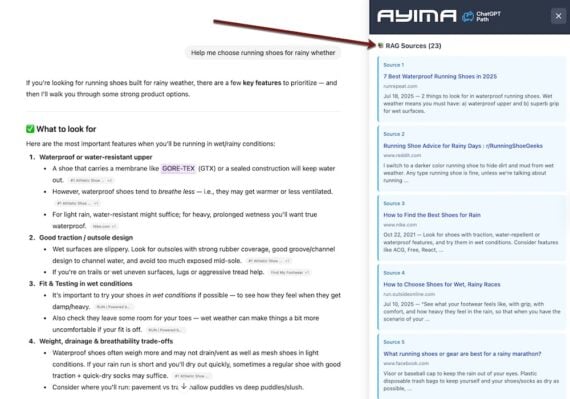
ChatGPT Path extracts citations, brands and products, and fan-out queries from any ChatGPT dialog, such as this example for “help me choose running shoes for rainy weather.”
AI Search Impact Analysis
AI Search Impact Analysis is another free Chrome extension that analyzes multiple queries on Google AI Overviews.
Install the extension and type your comma-separated queries into the tool’s sidebar. The tool will run each search and identify AI Overviews and the queries that triggered them.
A separate “Citation Report” includes all URLs cited in each Overview and overall for all queries. In my testing, this feature was handy for identifying URLs cited repeatedly.
The extension’s “Brand Check” analyzes mentions of your company and competitors in Overviews.
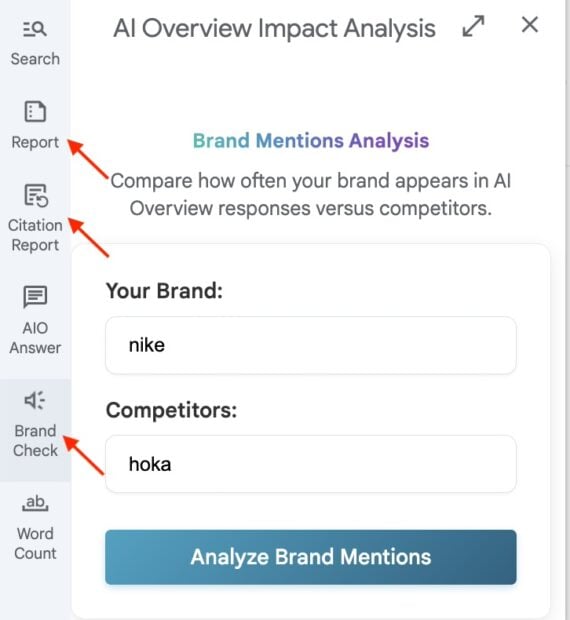
“Brand Check” analyzes Overviews for mentions of your company and competitors, such as “nike” and “hoka” shown here.
Peec AI
Peec AI is a premium analytics tool for sources and brand mentions in ChatGPT, Perplexity, and AI Overviews.
To use, enter your brand and targeted prompts. The tool, after a few minutes, will create a detailed report, listing:
- Domains cited in genAI answers for those prompts,
- URLs linked in the answers.
The report categorizes cited domains by type (e.g., corporate, brand-owned, user-generated) and frequency (to know a domain’s impact on a cluster of answers).
A separate aggregated report combines all genAI platforms, with URL filters for each one. The “Gap analysis” lists cited URLs that mention competing brands but not yours.
Finally, Peec AI analyzes all entered prompts and lists the most-cited brands to compare and track against your own.

Peec AI’s report categorizes cited domains by type and frequency.