Effective cart abandonment emails and text messages do more than remind shoppers about items left behind. They use product details, reassurance, and incentives to address customer concerns and reopen a conversion path.
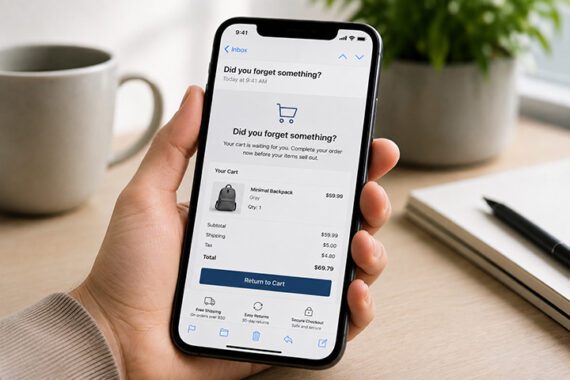
After three decades of online shopping, cart recovery remains important.
Obstacles
Most cart recovery programs rely on fixed sequences that cannot distinguish those concerns. That is because an abandoned cart records an outcome, not a reason. The merchant’s ecommerce platform knows which products the shopper left behind, but cannot immediately tell why.
Most obstacles fall into three groups.
- Transaction friction. The shopper may have been interrupted, encountered a payment problem, or found the checkout process difficult.
- Purchase uncertainty. Questions about fit, quality, compatibility, delivery, or returns may have delayed the decision.
- Offer resistance. The final price, shipping charge, product availability, or purchase timing may no longer suit the shopper.
Recovery Tactics
Given those obstacles, most cart recovery messages use corresponding tactics.
- Restore the order. Recreate the cart and provide a direct route to checkout.
- Reduce the hesitation. Address concerns about the product, delivery, or purchase risk.
- Change the offer. Add an incentive or an alternative.
Each tactic can recover a sale, but no single option fits every abandoned cart scenario.
Opportunity
About 70% of ecommerce shopping carts never convert, according to the Baymard Institute. That’s a lot of money left on the table. Hence most ecommerce marketers have at some point set up recovery automations.
Abandoned cart email remains the baseline recovery channel, with an average open rate of 50.5% and a conversion rate of 10.7%, according to a Ringly article. SMS and phone outreach can outperform email on engagement and recovery.
Fixed Sequences
Many cart abandonment automations use predefined triggers and branches. A merchant chooses the delay, prepares the messages, and establishes the conditions for an offer.
Those rules make cart recovery manageable, but they require merchants to anticipate every variation. A large catalog can include products with different margins, consideration periods, and customer concerns. No single sequence can reflect all of them.
Fixed sequences also make broad assumptions. The automation may send a coupon to a shopper who planned to return without one. Or it might emphasize product features when shipping cost caused the abandonment in the first place.
Bottom line, marketers really have two options to improve cart conversions and recovery: manual optimization or AI decisioning.
Optimization
A merchant who takes the manual approach can focus on four areas.
- Avoid the problem altogether. The first goal should be to reduce the store’s own cart abandonment rate. Aim to beat Baymard’s 70% average with clear pricing and transparent shipping costs. A/B tests can help.
- Employ sequences in multiple channels. One email may miss the shopper or fail to address the cause. Instead, use a coordinated sequence that combines email and text messages.
- Have many sequences. In addition to multiple channels, consider different recovery automations depending on the margins, consideration periods, and customer concerns.
- Use retargeting ads. Paid retargeting can keep abandoned products visible, while email and SMS provide more detailed recovery messages. Limit frequency, exclude completed buyers, and avoid presenting an offer that conflicts with the email sequence.
Manual optimization requires better measurement. Revenue per recipient shows the value of each sequence, while control groups — folks who don’t get the messages — reveal whether the outreach generated incremental sales or merely claimed credit for shoppers who returned on their own.
AI Decisioning
A second recovery option could be what customer engagement platforms call “AI decisioning.”
An AI decision system evaluates customer and cart signals, compares approved recovery tactics, and selects the message, offer, and timing most likely to produce the merchant’s chosen outcome.
The merchant would still control the strategy and create treatments such as reminders, product reassurance, free shipping, or discounts. Merchants would also establish limits on margin, message frequency, and promotion eligibility.
The AI would then make individual decisions about when and how to deploy each message or offer. It could consider cart value, product type, purchase history, and the shopper’s behavior leading up to abandonment.
This is different from conventional email automation. Fixed sequences execute a merchant’s instructions. AI decisioning evaluates those choices for each shopper and learns from the resulting purchases, ignored messages, and lost carts.
An AI model would not know the shopper’s reason for leaving, but it would make an informed attempt based on which tactics have produced the best results for similar shoppers under similar conditions.
Cart Recovery
Cart abandonment automations should do more than remind shoppers what they left behind. Whether marketers optimize sequences manually or employ AI decisioning, the aim should be to identify the most likely obstacle and remove it.