Early data suggests that AI-aided shopping could lower product returns, one of ecommerce’s most persistent costs.
That possibility is easy to miss in Adobe’s August 2026 “AI Traffic Trends Report” (PDF). The report, based on Adobe Analytics data of “over 1 trillion visits to U.S. retail sites, 100 million SKUs,” includes Adobe’s July 2026 survey results of 5,000 U.S. consumers
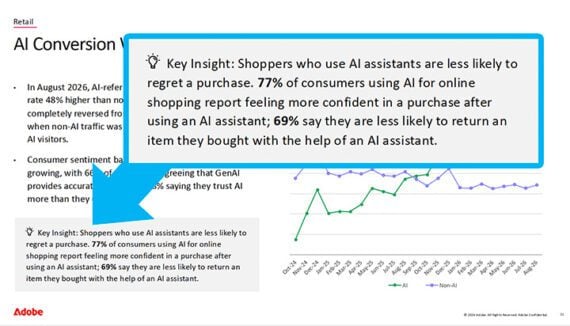
Adobe addressed ecommerce returns in a relatively small section of its 59-page Traffic Trends Report.
Some 69% of respondents to the Adobe survey who had used AI for online shopping said they were less likely to return an item purchased with AI assistance. Meanwhile, 77% of those respondents said using an AI assistant made them more confident about a purchase.
Based on those responses, AI shopping:
- Provides more and better product information.
- Reduces purchase uncertainty.
- Improves the match between a shopper and a product.
- Produces fewer returns.
Informed Shoppers
Adobe’s data suggests shoppers arriving on merchants’ websites from AI platforms tend to know what they want.
In July 2026, AI-referred retail visitors converted 60% higher than non-AI-referred site traffic, according to Adobe. Those AI-referred consumers generated 53% more revenue per visit.
Before AI, a shopper might have visited several ecommerce sites to compare features, dimensions, compatibility, reviews, and prices. In 2026, an AI assistant can perform much of that research before recommending a store and a product.
Meta’s Muse is a timely example. It can use its own virtual web browsers to visit dozens of ecommerce sites before recommending a product. Thus the referral may occur after the shopper, via the AI, has narrowed the choices and resolved uncertainty.
Product Information
For ecommerce merchants, the takeaway may be less about AI traffic and more about product information.
AI assistants can reduce purchase uncertainty only when they have accurate, extensive information — specifications, dimensions, compatibility details, variants, delivery estimates, reviews, FAQs, and comparisons.
These details can help an AI assistant determine whether a product actually fits a shopper’s needs before recommending it.
The potential benefit goes beyond winning an AI recommendation. If better product information helps an assistant recommend the right product to the right shopper, merchants could gain both a sale and fewer returns.
Returns
It is too early to know whether AI-aided shopping will meaningfully reduce ecommerce return rates.
Still, the evidence makes sense. Better-informed shoppers are more likely to purchase items they will ultimately keep.
Fewer returns could become a valuable benefit of AI-aided shopping.