U.S. merchants eyeing European expansion see 450 million consumers unified under common trade regulations. The reality is different. The European Union harmonizes cross-border commerce rules, but it doesn’t harmonize the people doing the buying.
This misunderstanding costs conversions in every country. Without payment after delivery, German shoppers bounce. Absent the French language, buyers in France lose trust. Parcel delivery lockers are critical for Polish consumers.
Yet U.S. merchants launch uniform “European” storefronts and wonder why conversion rates lag. The problem is they’re treating many distinct cultures as one.
- The European Union consists of 27 member countries and operates with 24 official languages.
- In 2023, 75% of Europeans made at least one online purchase.
- 86% of businesses selling online use their own website or app, while 45% also rely on marketplaces.
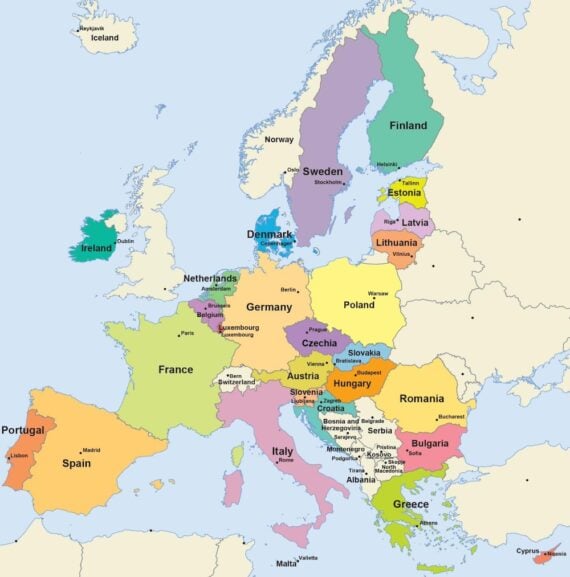
The E.U. consists of 27 member countries and 24 official languages.
One Europe, Many Markets
I’m the co-founder of a digital marketing agency in Poland. For more than a decade, we’ve assisted ecommerce brands and technology providers in positioning themselves across Europe. Here’s what sets the major markets apart.
Germany: Precision and proof required
Online shoppers in Germany are detail-oriented and risk-averse. They expect comprehensive product specifications, comparison tables, and transparent return policies. Germany consistently produces the highest return rates in Europe, particularly in fashion and electronics.
According to Stripe’s 2023 payment behavior study, 43% of German shoppers prefer payment on invoice after delivery, enabling them to receive and confirm products before paying, which aligns with their strong focus on security.
France: Language and brand identity first
French consumers emphasize brand storytelling and visual presentation, with language as a key trust signal. Research from the European Commission shows that most E.U. consumers prefer to browse and shop in their native language, and many avoid foreign-language sites altogether.
In France, this preference is even more pronounced: Studies reveal that three out of four consumers favor buying products presented in French, and most rarely (or never) complete purchases on English-only sites.
Moreover, French buyers gravitate toward culturally attuned sellers. They expect localized ecommerce experiences not just in wording but also in photography, tone, and native nuances.
Nordics: Digital sophistication meets sustainability
Consumers in Scandinavia are among Europe’s most digitally advanced. Mobile commerce is prominent, accounting for nearly 40% of sales by 2027. Buyers expect frictionless mobile experiences, quick checkout, and are generally willing to pay more for quality and convenience.
Sustainability is a priority. Shoppers seek details on sourcing, materials, and environmental impact rather than vague claims.
Payment preferences vary by country. Klarna remains dominant in Sweden; MobilePay is popular among Danish consumers, and Finnish buyers favor bank transfers.
Southern Europe: Price sensitivity and delivery focus
Shoppers in Spain, Italy, and Portugal are more price-sensitive. Promotional campaigns and limited-time offers typically perform well, as consumers compare prices closely before buying. They are also among the fastest E.U. adopters of mobile commerce.
Shipping expectations are key. A 2022 survey by Seven Senders, a Berlin-based logistics firm, found that many Italian shoppers tolerate higher shipping costs for guaranteed fast delivery. Hence clear, reliable delivery information is critical, particularly in Spain and Italy, with many first-time buyers expecting service transparency.
Central and Eastern Europe: Marketplaces and value seekers
Poland, Czechia, and Romania are among Europe’s fastest-growing ecommerce markets — the region collectively recorded a 15% increase in B2C turnover in 2023. Yet consumer behavior here differs sharply from Western Europe.
Domestic marketplaces shape much of Eastern Europe’s ecommerce landscape.
- Allegro dominates in Poland, generating €12.8 billion in gross merchandise value ($14.8 billion) in 2024 and capturing nearly half of the country’s online retail market.
- In Romania, eMAG plays a similar role with €1.3 billion in GMV ($1.5 billion), leading key categories such as electronics, fashion, appliances, and toys.
- In Czechia, Mall.cz (part of the Allegro Group) and Heureka are the most popular.
Unlike Western Europe, where Amazon is dominant, regional players drive ecommerce in Central and Eastern Europe.
CEE shoppers rely heavily on reviews and social proof, which makes established marketplaces — Allegro, eMAG, Mall.cz — a practical first step for new sellers before moving to standalone sites.
True Localization
True localization means adjusting the entire value proposition to match how consumers in each market shop, decide, and pay.
The E.U. opportunity for foreign merchants is enormous yet daunting. Partnering with a regional ecommerce consultant or local technology providers can help identify the right mix of payments, logistics, and platforms for each country.