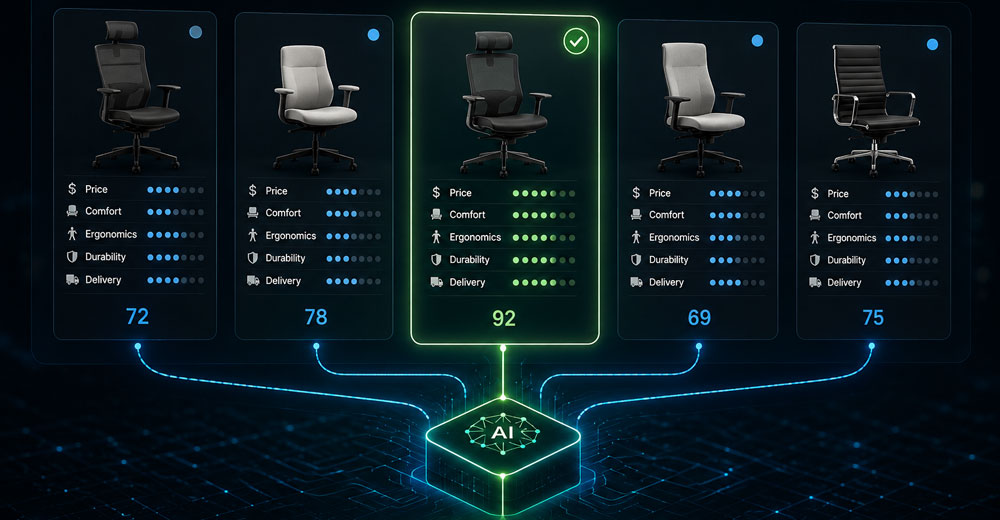
AI agents are moving beyond assisting with purchases to making them, raising new questions about trust, marketing, procurement, and customer experience in both B2C and B2B commerce.
As AI takes a more active role in purchasing decisions, company leaders must answer important questions about how they should rethink generative engine optimization (GEO) strategies and what their marketing teams should prioritize when creating content that resonates with AI buyers.
The shift toward autonomous AI buyers requires businesses to rethink how the traditional marketing funnel functions when the decision-maker is an algorithm rather than a human.
Matt McGinnis, VP of product, industry, and solution marketing at Five9, an AI-powered customer experience (CX) solutions platform, is concerned about the broader implications of AI taking on the role of the buyer and what it means for businesses moving forward.
Over time, Five9 expects enterprises to deploy negotiation-aware AI agents that represent the seller’s interests when interacting with autonomous buyer-side AI agents. As AI begins participating directly in procurement, companies will need intelligent systems that can dynamically protect margins, enforce policy guardrails, preserve brand positioning, and optimize commercial outcomes in real time.
However, McGinnis cautioned that the long-term opportunity extends beyond AI negotiating against AI. The market is moving toward trusted orchestration frameworks where enterprises balance automation with governance, transparency, and business intent.
Five9’s broader agentic CX vision is AI systems that can reason, adapt, and take action while still operating within enterprise-defined trust and governance controls. In that world, successful companies will not just deploy aggressive optimization agents.
“They will deploy AI systems that understand customer context, business objectives, compliance requirements, escalation thresholds, and relationship value while enabling intelligent automation without reducing every interaction to a price competition,” he told the E-Commerce Times.
Trust Remains a Barrier to Full Buying Autonomy
McGinnis says no. In his view, giving AI agents that much purchasing power comes down to one word: trust. Businesses and consumers must understand what that involves. In practical terms, that means the AI agent follows provided directions, performs the proper analysis within its parameters, and selects the right product or service at the right price, delivered on time.
“Purchasing is a complex series of data points and decisions that result in taking an action involving real dollars. That real dollar impact is the clearest measure of whether AI successfully performed the pre-purchase analysis,” he said.
Effective automation requires that AI prompts, rules, and decision parameters be tested and refined over time. The key question is whether a particular purchase scenario is predictable enough to automate while reducing repetitive tasks for humans, he added.
McGinnis offered this example: In wholesale, AI can help trigger restocking when inventory is low, and purchase velocity is rising, preventing stockouts within defined parameters. But for a diamond supplier with inconsistent customer needs, automation may be too risky, especially if purchasing mistakes leave costly inventory sitting idle for some time.
“Ultimately, AI automation is circumstantial as trust is built to overcome the risk of errors,” he said.
Optimizing Commerce for AI Decision-Making
When AI agents act as buyers, the traditional awareness-consideration-conversion funnel persists, but it will evolve to accommodate AI-driven purchasing behavior, according to McGinnis. The funnel now requires optimization to support rapid data ingestion, analysis, and decision-making by AI agents acting on buyers’ behalf.
He also sees the potential need for platform developers to standardize methods for selection and purchasing, such as a reinvented AI-native shopping cart process, to enable widespread adoption at scale.
“Search engine optimization has always required balancing content written for humans with content structured for machines. With GEO, the same dynamic continues, but now content must also be optimized for AI systems to discover, ingest, and act upon,” he said.
McGinnis noted that GEO is both a new science and an art that AI-empowered businesses must embrace to succeed in this emerging AI buyer paradigm.
Preparing Content for Human and AI Buyers
As AI optimization takes precedence, marketers will increasingly focus on ensuring AI buyers can understand a product’s exact specifications. McGinnis predicted a greater emphasis on structured, high-density data formats designed for AI systems.
“However, the best practice will require a balance until we reach a majority of purchasing by AI. Humans remain the primary buyers and decision-makers, meaning that visual marketing continues to play an important role,” he noted.
In the near term, the greatest opportunity will be to add AI-optimized content to the purchasing process. This will make it easier for AI-driven buyers and agents to discover and recommend products.
Five9 sees a future in which AI agent buyers become a significant economic force. Customer service organizations, including expansion into the pre-purchase buyer phase, will become even more important for companies like Five9 to service.
In this new era of customer experience, McGinnis envisions that human-to-human, human-to-AI, AI-to-human, and AI-to-AI interactions will all need support. This evolution is redefining how businesses engage, sell, and discover value.
Brand Loyalty Will Remain Key to AI Buyers
According to McGinnis, brand trust will still matter in the age of AI. A brand represents a set of expectations. Humans rely on trusted brands to simplify purchasing decisions. AI systems are likely to use brand credibility as one of several key decision variables.
For example, an engineering company that makes widgets to very tight tolerances can maintain a reputation for excellence in this category. The AI agent buyer can likely assess the level of trust to meet specific tolerance standards, alongside additional purchasing criteria that may inform the decision.
“In that sense, what a brand stands for will remain highly relevant in future purchasing models,” he suggested.
Guardrails Remain Vital to Guard Against Hallucinations
As autonomous buying increases, so does the risk of errors in high-speed, automated procurement. Businesses should implement safeguards to ensure their AI buyers do not fall into hallucinated purchasing traps.
During the e-commerce shift during the dot-com era, consumer expectations around shipping speed, cost, and convenience forced a complete rethinking of logistics. Autonomous buyers will require a similar evolution in how they manage procurement risk, according to McGinnis.
He recalled that purchasing and delivery were not as expected, so the industry introduced processes such as advanced return refunds, free returns, and 24/7 customer service. E-commerce leaders quickly addressed procurement errors and maintained customer satisfaction.
In this new era of purchasing, businesses may need to revamp policies, improve product replacement processes, and refine methods for addressing AI procurement errors.
“In many ways, this industry is ripe for change, and I look forward to how AI-forward organizations will embrace making it right for the AI agent buyer,” McGinnis concluded.