The newest offering from management guru Joseph Pine takes his acclaimed 1999 bestseller “The Experience Economy” a step further. That book foresaw the rise of compelling consumer experiences as drivers of brand loyalty, more than material goods alone. Certainly such experiences have mushroomed over the last 25 years.
In “The Transformation Economy,” Pine now argues that experiences are not enough. Consumers want products and services that improve their lives and businesses. According to Pine’s “the progression of economic value,” agrarian manufacturing led to the industrial economy, which in turn led to services, and finally to experiences.
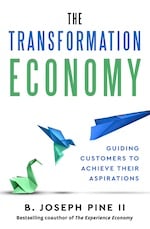
The Transformation Economy
Pine contends that people buy from companies to reach a goal. Businesses that understand those goals (what buyers hope to improve) can offer greater value. And that value can establish the price, more than the cost of materials or services.
The first chapter defines transformation in the context of what businesses sell. “You are what you charge for,” Pine asserts.
The second introduces the idea of human flourishing — “the true purpose of business” — in four spheres: health and well-being, knowledge and wisdom, wealth and prosperity, and purpose and meaning. The book cites Equinox Fitness Clubs and Fender Musical Instruments as offering transformation beyond selling gym memberships and guitars. Other examples include Eataly (food products), Burning Man (outdoor festival), the U.S. Army, Princess Cruises, and more, with insights from business leaders.
Pine explains how companies shift from offering experiences to transformations and the types and levels of each, all illustrated with helpful diagrams.
The final two chapters include questions for readers to apply in their own business. The book also includes copious notes and a comprehensive index.
What Customers Want
Most of Pine’s ideas fit high-end service businesses such as health and wellness, travel, and financial services. Getting to know each customer personally would be a tall order for a company selling groceries or household consumables.
However, Pine’s “jobs to be done” framework — what customers want to accomplish — is useful for any company. He asserts that “customers often don’t know what they want, and even when they do, they can’t always articulate it. You need to draw it out of them.”
Pine’s writing is conversational and clear. His “Mass Customization,” in 1992, was a best business book by both the Financial Times and Library Journal.
He co-authored “Infinite Possibility” in 2011, “Authenticity” in 2007, and “The Experience Economy” in 1999. The latter was an instant classic, still in Amazon’s top 10 for the product marketing category after 25 years and two updated editions.