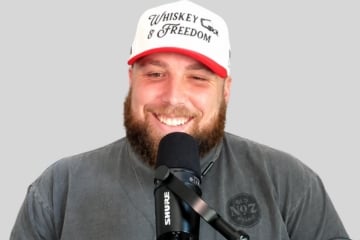
Nate Lagos is a seasoned ecommerce conversion optimizer, yet a recent A/B test surprised him.
A client used all-caps text in key landing page headlines. Nate, having read a tip on X, suggested they test headlines that capitalized only the first letter of each word.
The result? Conversions increased by 25%
Nate first appeared on the podcast in 2025, when he addressed Facebook ad performance. For this conversation, he focused on “bottoms-up” testing, audience targeting, and marketing male products to women.
Our entire audio is embedded below. The transcript is edited for clarity and length.
Eric Bandholz: What the heck do you do?
Nate Lagos: I launched my own brand, Shootin’ Doubles, last year. We sell hats for whiskey guys. It started as a fun side project. It has grown into a business with legs.
I left my full-time job to focus on that company, but I realized I needed to make more money. So I started an agency in May of this year called Bottoms Up: Performance Copywriting & CRO, where we test brands’ copy on-site, in emails, and in ad accounts. That’s been going well.
I’ve spent the last decade as an in-house performance marketer for ecommerce companies, including Adapt Naturals, Original Grain, and Dugout Mugs.
I’m an entrepreneur now.
Bandholz: How do you approach copywriting for conversions?
Lagos: I didn’t focus on conversion copy until I worked at Original Grain, makers of wooden watches, about five years ago. I was selling something with little utility. Everyone owns a phone to tell time; no one needs a watch. So I started to investigate why people buy a watch, why the category even exists.
I realized that a watch is much more than a timekeeping device. It’s a sign of status, a symbol of accomplishment. We tested messaging targeting that persona. Conversion rates, average order value, revenue per visitor — all moved aggressively in the right direction.
We increased revenue nearly fivefold in the five years I was there. A lot of it was due to improved storytelling and copywriting.
Many creative strategists implement top-of-funnel advertising ideas. They start with what they think is top of mind for prospects. I take a bottoms-up approach. Top-of-funnel is typically far from an actual purchase decision. Often, it’s not even related to the products.
A bottoms-up strategy means testing copy as close as possible to the add-to-cart button — headlines, product detail pages, even home pages. I want to know what entices someone to buy or to bounce.
Once we know that, we understand what buyers are really after. And once we understand that, we can go right to top-of-funnel ideas that attract the right kind of intent.
We’ll compose the core advertising message to be more attention-grabbing, more scroll-stopping.
And 90% of the time, we’re using Intelligems to A/B test everything. It’s a great tool.
Bandholz: What is the required volume for meaningful test results?
Lagos: Tens of thousands, if not hundreds of thousands, of site visitors and thousands of orders. I aim for statistical significance with an 80% or higher likelihood of beating the control. Ongoing iteration is essential.
A heat map tool will show what visitors are reading and spending time on. Those are the high-impact, high-leverage areas, typically landing pages, home pages, product pages, titles, and headlines. The first block of copy on a page matters a lot.
Bandholz: What test results have surprised you?
Lagos: Avoid all caps is one. It’s apparently a legibility thing. I haven’t tested it on buttons, but headlines and site copy don’t have to be in all caps. I can’t take credit for the idea, as I read it on X.
I recently tested it for a client who used all caps in headlines. I ran an alternative test that capitalized only the first letter of every word. It produced a 25% increase in conversions on a high-traffic landing page and a lower cost per acquisition. I was surprised.
I’ve seen similar results with headlines in smaller text rather than large.
Both of those suggest easy-to-read copy.
Bandholz: What a growth strategy for a brand that’s saturated its core audience?
Lagos: Use products as a growth lever. Always ask, “Who else could we target?”
When I started at Original Grain, about half of our customers were women, yet we had only messaged men before that. We got very good at messaging women, who became 80% of our customers, and the business kept growing.
For your company, Beardbrand, maybe there’s an angle to sell beard oil to women who are tired of kissing husbands with scratchy beards. Before launching a bunch of expensive and time-consuming products, think about who else to sell to.
Bandholz: What is your advice for selling to women?
Lagos: Hire a woman. I hired Sarah Levinger when I got to Original Grain. I did not know her before then. When I found out half our customers were women, I approached her. I said there’s a massive opportunity to sell men’s watches to women as gifts for their husbands, boyfriends, dads, and brothers, but I have no clue how to do it.
She coached me a ton. We did great work together.
When it comes to gifts, it’s simple. Females want to make sure they show appreciation for what their husbands do for them. At Original Grain, it was women in traditional households, with husbands doing most of the outside work and earning income. It was her way of saying, “Thank you. I appreciate you.”
For the 30 days before Father’s Day and the 45 days before Christmas, our messaging aimed at female gift buyers. During the year, the main website focused on men.
Bandholz: Where can people follow you, hire you, or reach out?
Lagos: Follow me on X. Listen to my podcast, “Tactical and Practical Marketing.” I’m also on LinkedIn.