EU consumers spend a disproportionately large share of their online fashion budgets abroad. Fashion accounts for 46.2 percent of all online spending at non-EU retailers, followed by electronics as the second-largest category.
This is according to figures from ECDB. In the data provider’s classification, fashion ranks third in terms of total online consumer spending within the European Union. Last year, the category accounted for 18.7 percent of spending, compared with 21.8 percent for market leader hobby & leisure and 21.6 percent for electronics.
Very different
The picture for cross-border spending differs considerably from that for overall online spending in Europe. “European online shoppers regularly order from retailers outside the EU. What they buy there looks very different from what fills their baskets at home”, ECDB writes. Fashion is by far the largest category in cross-border spending, as the chart below shows:
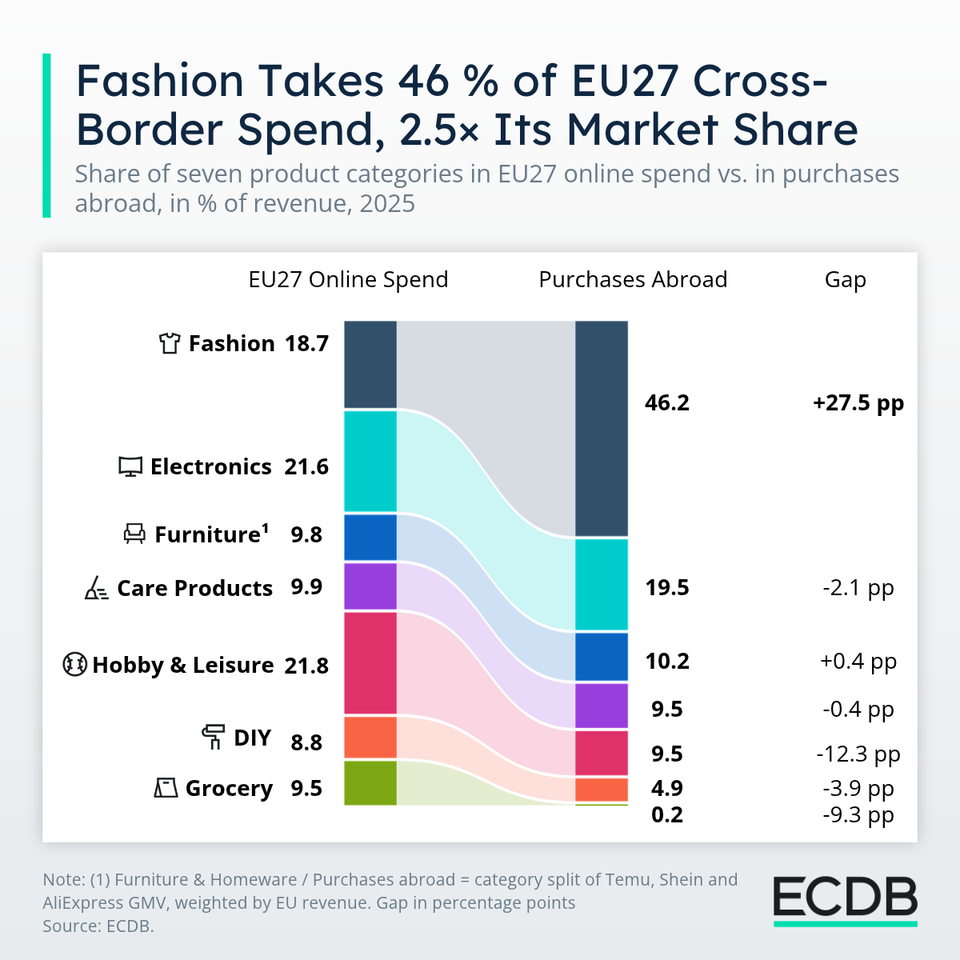
The share of cross-border spending on hobby & leisure is considerably smaller than its share of overall online spending. For electronics, the difference is less pronounced. Grocery shopping, meanwhile, remains a predominantly local affair. As with fashion, furniture accounts for a larger share of cross-border spending than of overall online spending, although the difference is relatively small.
China dominates
EU consumers spent a total of 55.1 billion euros at retailers outside the EU on physical goods last year, ECDB previously reported. This represents 13.1 percent of their total online spending. Of that amount, 49.7 billion euros was spent on Temu, AliExpress and Shein. ECDB links fashion’s high share of cross-border spending to the popularity of these platforms: “When the biggest third-country players are fashion-first, the category mix of cross-border spending follows them.” Another factor is that clothing is light, compact and unlikely to break. “Light, cheap and durable goods cross borders best”, ECDB concludes.
China’s cross-border share exceeds 90%
Last year, Temu, AliExpress and Shein accounted for more than 90 percent of all EU online spending at non-EU retailers. Temu, which is implementing an action plan to combat the spread of illegal products, even ranked as the largest ecommerce player in four European markets.
Parcel fees
The European Commission is seeking to curb the influx of parcels from China through various fees. To avoid these charges and speed up deliveries, the platforms are opening warehouses on European soil.