Retail apps often have a short lifespan after customers download them, according to recent Adobe research.
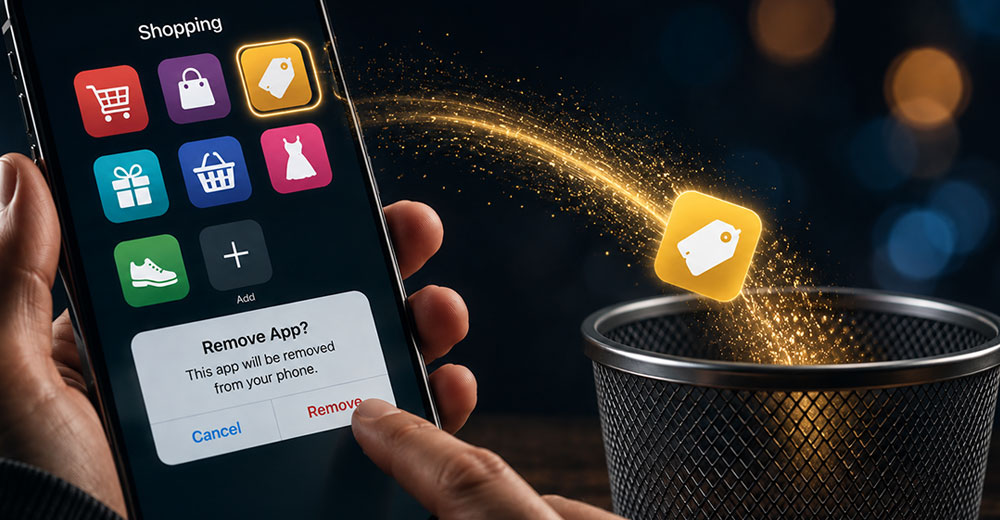
Nearly three out of four customers (72%) say they downloaded a retail app for a one-time discount or purchase and eventually deleted it, Adobe discovered through a survey of 1,000 U.S. consumers.
The researchers maintained that level of app churn signals a broader shift in customer expectations. “Discounts may drive installs, but they rarely drive long-term retail app retention on their own,” they noted.
Adobe researchers also found:
- The top reasons customers download retail apps are to join a loyalty or membership program (45%), receive a one-time discount or promotion (42%), and have an easier shopping experience (37%).
- The top reasons customers uninstall retail apps are that they’re no longer needed for their original purpose (64%), take up too much storage (43%), or lack ongoing relevance or utility (43%).
- The top notifications that drive retail app engagement are order status updates (39%), personalized discounts (37%), and price drops on saved items (33%).
- One in three users say they would be more likely to keep a brand or retail app on their device if they could interact through voice or image search (33%).
Taken together, the findings suggest that getting consumers to install a retail app may be easier than giving them a reason to keep using it.
Retention Strategy Lacking
“Most retail apps have an acquisition strategy, but not a retention strategy,” explained Katherine Black, a partner and food, drug and mass market lead at global strategy and management consulting firm Kearney.
“Retailers give consumers a compelling reason to download the app — a discount, loyalty points, early access — but often very little reason to come back once that immediate need is satisfied,” she told the E-Commerce Times.
Black added that the bigger issue is that many retail apps are essentially smaller versions of the retailer’s website. “If I can browse products, check prices and complete a transaction just as easily on the web, why should I give an app permanent real estate on my phone?” she asked.
Rich Pleeth, co-founder of Finmile, an AI-powered logistics software company in London, England, agreed. “Retailers still mistake an app download for the start of a relationship,” he told the E-Commerce Times. “That’s normally not the case. Usually, the customer just wanted a discount or to complete one transaction.”
“If the app then offers little beyond the website and sends constant promotions, deleting it usually happens next,” he said.
“The apps that survive are the ones that develop a distinctive job in the consumer’s life beyond simply facilitating a transaction,” he added.
Building Apps Customers Keep
Mark N. Vena, president and principal analyst at SmartTech Research, a technology advisory firm in Las Vegas, contended that the “best” retail app is one that is useful even when the customer is not in an active buying mode.
“They have smart product discovery pre-sale, smooth checkout in-sale, and order tracking, support, loyalty perks, and personalized recommendations post-sale,” he told the E-Commerce Times.
Make payments, rewards, and refunds part of the core app experience, added Prashant Shah, vice president of product management at SoFi Tech Solutions, a provider of API-based banking, payment-processing, and card-issuing infrastructure based in Salt Lake City.
“Let customers store a card and see rewards before checkout, pay in fewer steps at checkout, and have access to fast, transparent refunds afterward,” he told the E-Commerce Times.
“Our research has found that when payment methods are saved in a brand app, 20% of consumers report buying from that brand more often, 18% spending more overall and 16% spending more per purchase,” he said.
Kearney’s Black added that retailers need to think less about adding features and more about creating recurring utility.
“The question retailers should ask is: What can I do for this customer that becomes more valuable because I know them over time?” she said. “That’s where an app has an advantage over a one-off website visit.”
Beyond One-Time Promotions
The Adobe researchers also maintained that the next phase of e-commerce customer experience will be shaped less by one-time promotions and more by utility, personalization and value across the entire customer journey.
“To add real value, modern retail apps must leverage past shopping behavior, ongoing search intent and product viewing history to curate a user experience that anticipates the customer’s next move, followed up with tailored promotions, deals and messaging,” observed Andre Inverdale, founder and managing consultant of the Ardinal Strategy Group, a management consulting firm in Atlanta.
“A prime example of this added value is visual search capability, which allows a customer to upload a screenshot from an online post or video and instantly locate the exact product or a close alternative,” he told the E-Commerce Times.
While promotions will always have a role in retail, competing primarily on discounts is a difficult race to win, asserted Ramain Fouache, CEO of Akeneo, a product information and experience management company in Nantes, France.
“Consumers have more choice than ever, and a one-time offer may drive a transaction, but it rarely creates a lasting relationship,” he told the E-Commerce Times. “The better thing to focus on is ensuring that every interaction is useful and relevant.”
Conversational Commerce
The shift in focus to the entire customer journey is also accelerating the rise of conversational commerce, the researchers noted, an approach that allows customers to search, compare products, ask questions, and complete purchases through natural, conversational interactions instead of static navigation menus.
Customers increasingly expect retail apps to function less like digital catalogs and more like responsive, AI-powered retail assistants, or concierges, that adapt to their intent in real time, they added.
Adobe found that 65% of consumers want AI-powered order tracking and status updates in retail apps, while 57% want loyalty and rewards tracking and 42% want instant returns processing.
“Over the past 18 months, we have seen returning shoppers engage with conversational concierges more than first-time visitors,” said Ashu Dubey, founder and CEO of Alhena AI, a San Francisco-based company that specializes in AI-powered customer experience solutions for e-commerce.
“Once customers experience the concierge and understand how it helps, they come back and use it more deeply,” he told the E-Commerce Times. “There is a strong argument that the concierge can become part of the retention loop and turn returning shoppers into power users.”
Think Before You App
Before retailers launch an app, they should analyze what is working best in their segment, then figure out the most cost-effective way to deliver it, advised Rob Enderle, president and principal analyst at the Enderle Group, an advisory services firm in Bend, Ore.
“In most cases, they’ll likely come to the conclusion that the cost and risk of an app are less effective and more costly than a similar web effort,” he told the E-Commerce Times.
“An app is not built for engagement simply because of the friction involved in accessing the app,” contended Barbara Casey, CEO of Mobile High 5, a managed marketing services company for SMBs based in Malvern, Pa.
“It requires finding the app on your phone and opening it,” she told the E-Commerce Times.
“Engagement using SMS is a better alternative,” she argued. “It can reach a broader audience — not just those who downloaded an app — and messages [can] appear on the locked screen of a smartphone.”