As fleets of autonomous robots expand across warehouses and retail operations, the robots-as-a-service (RaaS) market is projected to grow more than 30% annually through 2030 — driving demand for more reliable wireless connectivity than traditional Wi-Fi can provide.
Private 5G networking firm Celona and connectivity provider Digi International began delivering the next generation of RaaS at scale for major retail operations in January. They recently explained their new technology at the National Retail Federation (NRF) as a unique, private 5G connectivity system that prevents robots from falling offline, compromising safety, and accidentally destroying inventory.
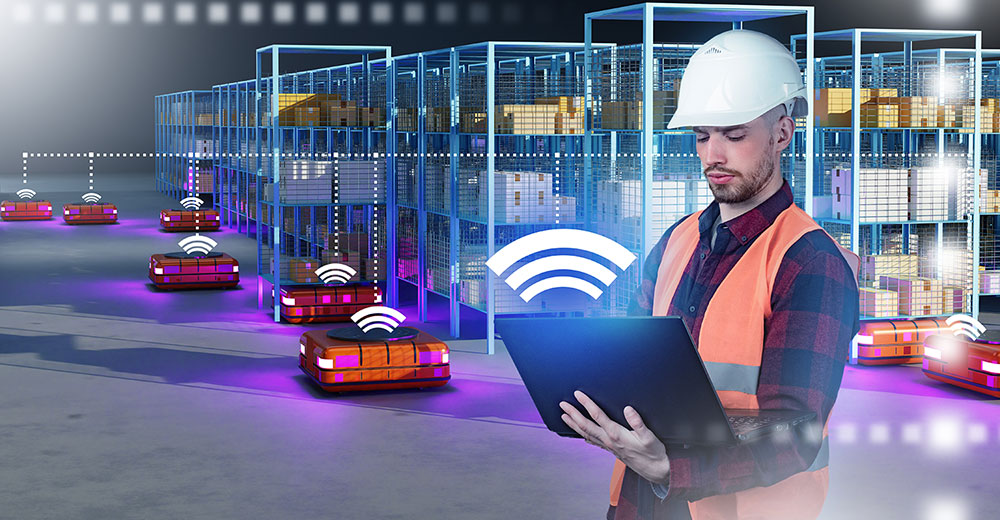
The two companies teamed up to integrate Digi’s industrial edge devices and gateways with Celona’s private 5G LAN platform. That means Digi-certified hardware, such as rugged routers and internet of things (IoT) gateways, works natively to improve reliability in warehouse operations where traditional Wi-Fi struggles.
Inventory tracking using computer vision, autonomous robots, and connected workers requires low-latency, high-capacity wireless networks. Digi’s industrial routers and edge devices bridge the gap between legacy equipment such as programmable logic controllers (PLCs), sensors, and private networks, making it easier to deploy and scale automated systems across retail environments.
Mehmet Yavuz, co-founder and CTO of Celona, emphasized that reliable connectivity is essential for safe, high-performing retail environments.
“We discovered that many of the robots or autonomous mobile robots (AMRs) don’t have the 5G module embedded,” he told the E-Commerce Times.
Amir Bushehri, strategic alliance director at Digi, said such vehicles are common in warehouses, distribution centers, and manufacturing environments.
“In the old days, there were more automated guided vehicles [AGVs] that moved along magnetic tape or rods. Today’s warehouse robots are becoming increasingly autonomous, and they need better connectivity because of safety requirements,” he told the E-Commerce Times.
Why Wi-Fi Fails Warehouse Robots
AMRs use onboard sensors, cameras, and AI to navigate, map, and move materials through facilities without fixed paths, markers, or constant human guidance. Unlike AGVs, they dynamically plan routes to avoid obstacles, making them ideal for dynamic warehouse and manufacturing environments.
Bushehri explained that AMRs move around, guided from one radio to another. Operators need to know where these devices are at all times. If the vehicles fail to signal a heartbeat and suddenly shut down, it poses a significant operational safety risk.
“It needs a heartbeat. If you lose two heartbeats, for example, most typical systems will shut down. And it’s a big deal now for someone to go chase that robot on the shop floor and report that,” he said.
Given Wi-Fi’s limitations as robot fleets grow, private 5G can provide more reliable, lower-latency connectivity for warehouse automation.
“It works because we’re stationary. When you start moving at 40 miles per hour and add multiple robots to that network, Wi-Fi fails. Time and time again, the moment you go past two or three robots, it just fails,” he complained.
Robot Collisions Raise Safety Risks
Yavuz shared that the robot situation can be more chaotic than a busy highway. Another challenge is the command-and-control process.
“Each robot gets an order saying, ‘Okay, go to aisle X, shelf Y, and pick up item Z and bring it to location A.’ So, they constantly must get the commands in terms of what they need to do next,” he said.
Yavuz added that autonomous robots, similar to autonomous cars, use cameras and other vehicle features as safeguards. He focused on the safety concerns of operations in a warehouse with 500 robots.
“We have facilities like that, and they are going at 30 miles an hour. These things are moving along these tracks, but it is like a three-dimensional movement up to a certain shelf height. Then, in that aisle, you have a lot of these things going at very high speeds,” he cautioned.
Bushehri agreed that safety is a major concern. Collisions can occur because, by the time a moving robot stops after missing a heartbeat signal, another robot may still be connected and operating. That risk, along with concerns about human safety, underscores the need for reliable connectivity that Wi-Fi often cannot provide.
RaaS Emerges as a New Industry
The goal of creating the RaaS model was to help customers seamlessly connect robots to Digi gear and to Celona’s private 5G network. The collaboration simplifies integration and reduces deployment concerns for retail stakeholders.
“We worked with the robotic manufacturers so the customer was not left to find a solution in isolation,” Yavuz said. “At this point, the manufacturers don’t have the expertise in private 5G. That’s why we made it as a subscription service.”
Bushehri sees RaaS as unique. He said he is not aware of competitors identifying an industry problem and offering a complete solution.
“Our competitors sell the pieces of it, kind of like what we were doing originally with the end users. Nobody’s come together that I’ve seen with a full plug-and-play solution that’s fully supported and takes the work from the robotic manufacturers,” said Bushehri.
Their cooperation has become a partnership on the cloud platform they call Celona 5G LAN.
Private 5G vs Wi-Fi Economics
Yavuz agreed that many retail warehouse operators consider RaaS as an alternative to Wi-Fi. Sometimes, customers subscribe to the cloud service as a complement to a Wi-Fi-based robotic network.
“But in this case, in a warehouse, the customers have two options. They can either deploy maybe 100 Wi-Fi radios, or they can put five to 10 5G radios to control their robots,” he suggested.
Bushehri added that the service’s cost aligns with the OPEX (operating expenditure) business model, in which a company focuses on ongoing, day-to-day operating costs rather than investing large amounts of capital up front.
“It’s a monthly price versus having 10 robots costing $1,000 per robot. That fee includes centralized visibility, telemetry, and a fully supported solution. It’s a managed service on our end,” he reasoned.