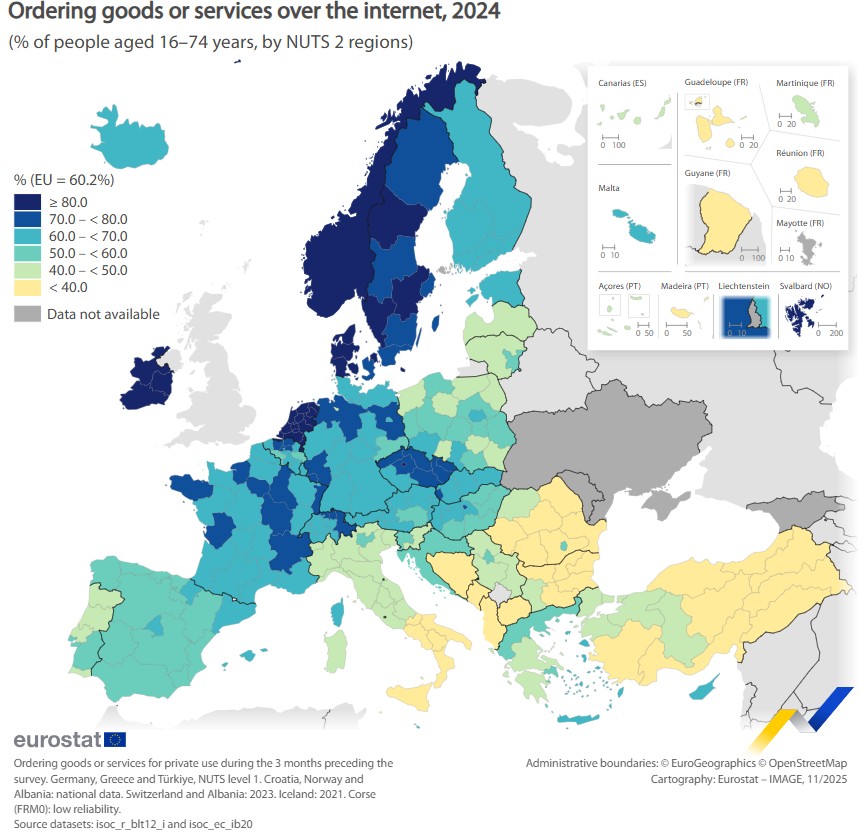
The adoption of ecommerce varies widely across European regions: from 21.7 percent in Yugoiztochen, in the southeast of Bulgaria, to 91.5 percent in the Dutch province of Utrecht. A new map from statistics agency Eurostat clearly visualizes these differences.
The map indicates the share of frequent online shoppers at the end of the previous calendar year: residents of a region who made an online purchase in the three months prior to the survey. Ecommerce in Europe is strongest in the northwest of the continent and declines towards the southeast.
Few frequent online shoppers in Italy
In Italy, a top-five player in Europe when it comes to online consumer spending, there are more people who do not buy online regularly than those who do (42 percent). The country is split in two: in the north, the percentage of frequent shoppers largely sits between 40 and 50 percent, while in the south it falls below 40 percent. Low adoption is also seen in several Balkan countries and in many regions in Romania, Bulgaria and Turkey, which was also included in the map.
Province of Utrecht
Nowhere is the percentage of frequent online shoppers as high as in the Dutch province of Utrecht. At the end of last year, 91.5 percent of its residents bought something online. Adoption in the other eleven provinces of what may be the most mature ecommerce country in the world also exceeds 80 percent (with a country average of 86.7 percent). In total, there are 23 European regions in which the share of online shoppers is above that level, according to Eurostat. It should be noted that some regions are much larger than others, either geographically or demographically.
12 of the 23 top regions are in the Netherlands
The other regions with more than 80 percent regular online shoppers are located in Denmark (four regions), Ireland (all three regions), Sweden (three regions) and the Czech capital region of Prague. In Norway (included as a country), adoption also sits just above 80 percent.